
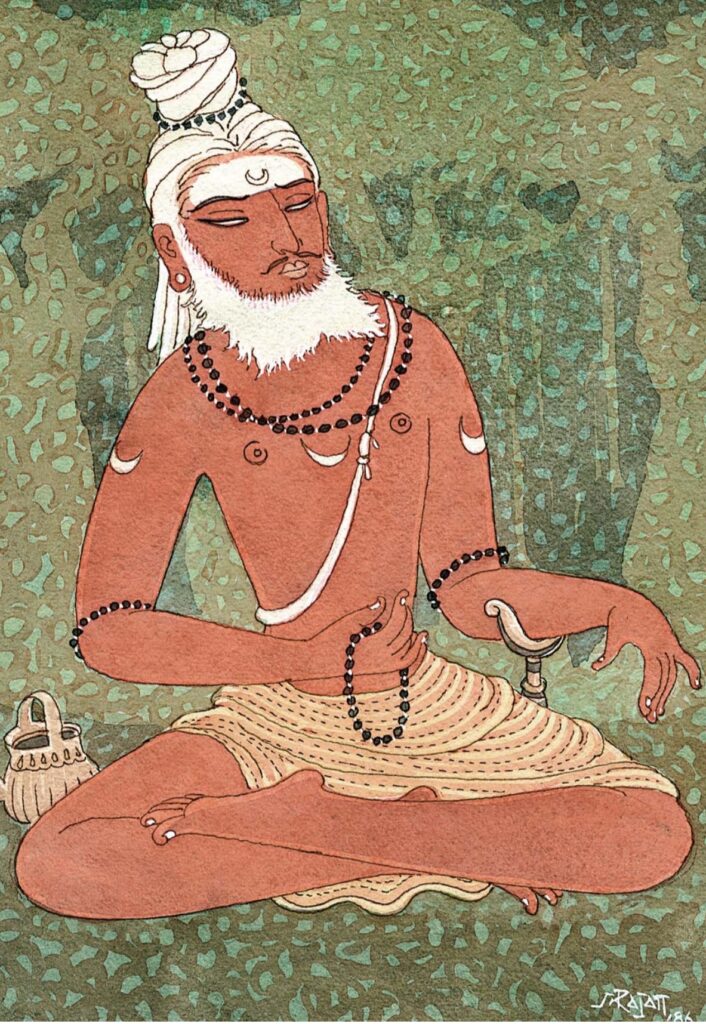
Sloka
The Pañchâkshara Mantra, Namah Sivâya, is repeated verbally or mentally, often while counting a mâlâ of rudrâksha beads, drawing the mind in upon itself to cognize Lord Siva’s infinite, all-pervasive presence. Aum.
Bhâshya
Japa yoga is the first yoga to be performed toward the goal of jñâna. In the temple perform japa. Under your favorite tree perform japa. Seated in a remote cave perform japa. Aum Namah Sivâya can be performed on rudrâksha beads over and over when the sun is setting, when the sun is rising or high noon lights the day. “Aum Namah Sivâya,” the Saivite chants. Aum Namah Sivâya feeds his soul, brightens his intellect and quells his in stinctive mind. Take the holy tears of Siva, the auburn rudrâksha beads, into your hands. Push a bead over the middle finger with your thumb and hold as the intonation marks its passage. The duly initiated audibly repeats “Namah Sivâya,” and when japa is performed silently, mentally chants “Sivâya Namah.” There are many ways to chant this mantra, but perform it as you were initiated. Unauthorized experimentation is forbidden. Those prone to angry rage should never do japa. The Tirumantiram announces, “His feet are the letter Na. His navel is the letter Ma. His shoulders are the letter Sí . His mouth, the letter Vâ. His radiant cranial center aloft is Ya. Thus is the five-lettered form of Siva.” Aum Namah Sivâya.